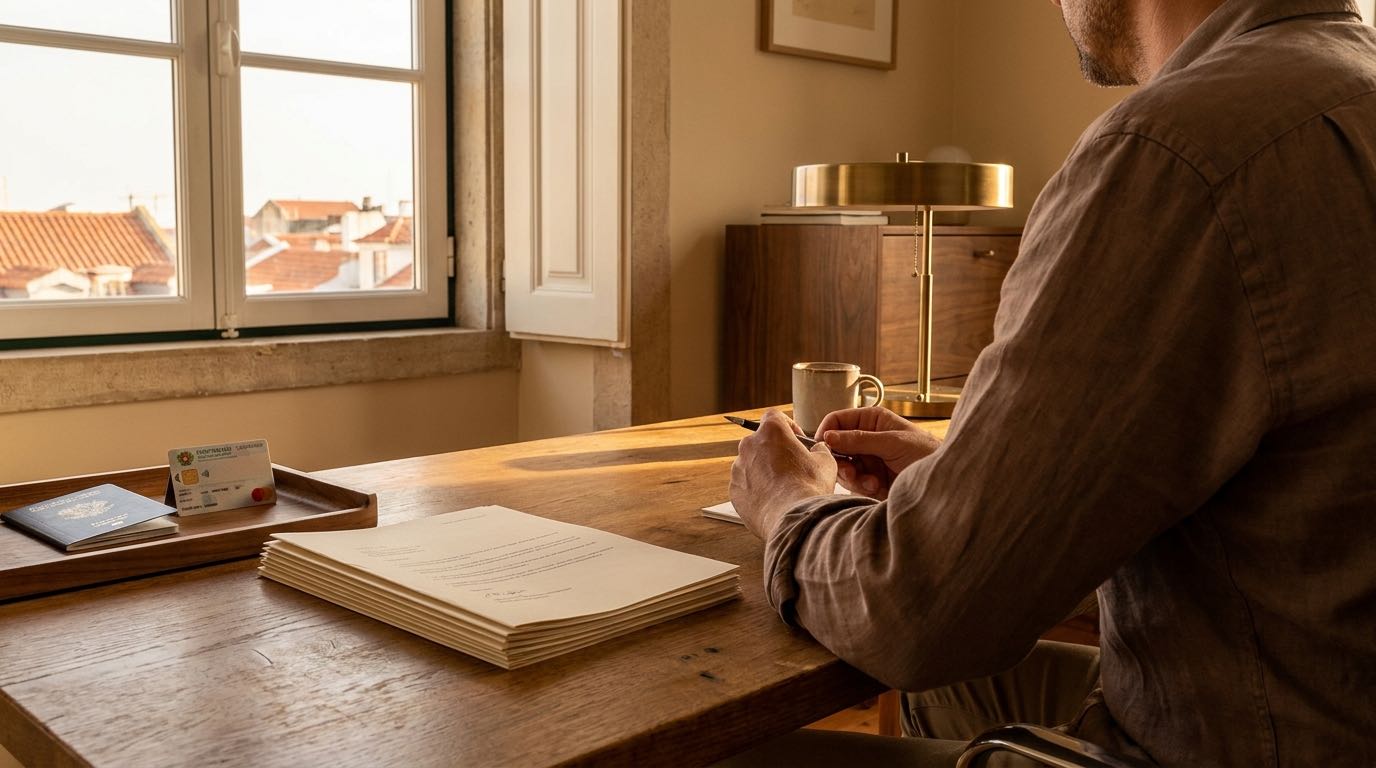


Your Golden Visa is not a one-time approval. You renew it every couple of years by proving you still meet the same conditions that got you approved: you still hold the qualifying investment, you have spent your minimum days in Portugal, and your criminal record is still clean. Renewal is mostly a re-proving exercise, not a new application. The single thing that trips people up is timing, because you want your renewal moving well before your current card expires.
This guide covers the renewal cycle, exactly what you need at each renewal, what it costs, how the AIMA backlog affects you, and why gap-free renewals matter for your path to permanent residency and citizenship. The first-time application itself, the portal steps and biometrics, lives in the how to apply for the Golden Visa guide.
Getting help with this Renewing a Golden Visa means tracking each renewal deadline and re-proving, on schedule, that you still hold the investment, met the minimum stay, and have a clean record, then filing before your card expires. An organized holder who diaries the dates and keeps clean evidence can manage it alone. In practice, the advantage of the assisted route is keeping the renewals continuous and gap-free through the AIMA backlog, which is the exact thing your residence clock depends on. Roots Global manages Golden Visa renewals and the AIMA process for clients, filing each period on time.
How does Golden Visa renewal work?
You renew your Golden Visa in periods, and each renewal simply confirms you still meet the program's conditions. Your first residence card is issued for an initial period; after that, you renew for successive periods until you reach the five-year mark and can move to permanent residency. Nothing about the underlying investment changes at renewal. You are showing AIMA, the immigration authority that administers residence-permit renewals (gov.pt), that the facts that qualified you still hold.
Under the current framework, the residence card is issued for an initial period and then renewed for successive 2-year periods (aima.gov.pt). The legal basis for the Golden Visa and its renewal is the ARI regime under Lei 23/2007.
The timing is what matters most. Because appointments and card issuance take time, you want to open your renewal well before the current card expires, not in the final weeks. Here is the cycle at a glance.
| Stage | Roughly when | What happens |
|---|---|---|
| First card | Year 0 | Issued after approval; your residence and clock begin |
| First renewal | Around year 2 | Re-prove investment, stay, and clean record |
| Second renewal | Around year 4 | Re-prove the same conditions |
| Permanent residency | Year 5 | Eligible to move off the renewal cycle (A2 Portuguese) |
The most common mistake I see is treating renewal as a formality and leaving it too late, then colliding with the appointment backlog. The full program overview and route map sit in the Portugal Golden Visa complete guide.
What do you need to renew your Golden Visa?
To renew, you assemble proof of the same conditions you met the first time, brought up to date. The core of the file is evidence that your qualifying investment is still in place, that you met the minimum stay for the period, and that your record is clean, plus current identity and tax details. None of it is exotic; the work is keeping it complete and current.
The one point holders underestimate is the investment. You must maintain the qualifying investment across the whole period. You cannot redeem the EUR 500,000 fund early and keep the Golden Visa, because the investment is the thing the permit rests on.
Here is the renewal checklist:
- Proof the qualifying investment is maintained (fund statement or equivalent evidence that the EUR 500,000 is still held).
- Proof of minimum-stay compliance for the period: an average of about 7 days a year, roughly 14 days across a 2-year period.
- A renewed criminal-record clearance (kept current for the renewal).
- A valid passport covering the renewal period.
- An up-to-date NIF and Portuguese address on record.
- Payment of the renewal fees for you and each family member.

The minimum-stay rule is light, but it is real, and it is the requirement people most often forget to document. The day count and how it is evidenced sit in the Golden Visa minimum stay guide, which owns that detail.
How much does renewal cost?
Renewal carries government fees, and they recur at every period and scale per person. Each renewal is a fresh set of ARI fees for the main applicant and for each included family member, so a family of four pays several times what a single applicant does, every renewal cycle. These are separate from the one-time costs you paid at the initial application.
The euro figures, and how the government, fund, and legal fees stack up across the whole hold, belong in the Golden Visa cost breakdown, which owns the full fee math. The point to plan around here is simply that renewal is a recurring, per-person cost, not a one-off.
What about the AIMA backlog?
Renewals have been caught up in the AIMA appointment and card-issuance backlog, and that is the honest reality to plan around. AIMA, which replaced SEF in late 2023, has faced well-documented delays in scheduling appointments and issuing cards. The good news is that a permit does not simply vanish because the authority is slow: where a renewal has been filed in time, the existing permit is generally treated as remaining valid while the renewal is pending. The practical defence is to renew early rather than at the last minute.

An immigration lawyer can manage the appointment process and the communication with AIMA, which removes much of the friction when the system is slow. The depth on processing times and the backlog itself, stage by stage, sits in the processing timeline guide.
How renewal keeps your residence clock running
Gap-free renewals are what preserve your legal residence toward permanent residency and citizenship. Each renewal keeps your residence continuous, and continuity is exactly what the milestones are built on: five years of unbroken legal residence gets you to permanent residency, and citizenship comes later, generally at about ten years, or seven for EU and Portuguese-speaking (CPLP) nationals.
A lapse can interrupt that count, which is the real cost of a late or missed renewal.

The year-by-year path, the 2026 nationality reform, and how the clock is counted are covered in full in the Golden Visa citizenship path guide.
See also
- how to apply for the Golden Visa (G4) for the first-time application, portal, and biometrics.
- Golden Visa minimum stay (S3) for the 7-day rule and how to evidence it.
- processing timeline (G8) for AIMA processing and the backlog, stage by stage.
- Golden Visa cost breakdown (G6) for the full fee math, including per-renewal costs.
- Golden Visa citizenship path (G9) for the residence clock, permanent residency, and citizenship.
Frequently asked questions
How often do I renew the Portugal Golden Visa? You renew in periods, not annually. Your first residence card is issued for an initial period, and under the current framework you then renew for successive 2-year periods until you reach the five-year mark and can move to permanent residency. Start each renewal well before the current card expires (aima.gov.pt).
What do I need to renew? Proof the qualifying investment is still held, proof you met the minimum stay for the period, a renewed clean criminal-record certificate, a valid passport, an up-to-date NIF and address, and the renewal fees. It is a re-proving exercise: you are confirming the same conditions that qualified you, brought up to date.
Do I have to keep the EUR 500,000 investment to renew? Yes. The qualifying investment must be maintained across the whole period, and you evidence it at each renewal. You cannot redeem the fund early and keep the Golden Visa, because the permit rests on the investment. You can move off the requirement only once you reach permanent residency at year five.
What happens if my renewal is delayed by AIMA? Where you filed your renewal in time, the existing permit is generally treated as remaining valid while the renewal is pending, so a backlog delay does not automatically break your status. The practical protection is to renew early, months before expiry, rather than at the last minute. Processing detail sits in the processing timeline guide.
How much does renewal cost? Renewal carries government ARI fees that recur at every period and scale per person, so each included family member adds to the bill each cycle. These are separate from your one-time initial-application costs. The full euro figures and how fund, legal, and government fees stack up are in the Golden Visa cost breakdown.
Does renewal count toward permanent residency and citizenship? Yes, and that is the point of renewing on time. Continuous, gap-free renewals keep your legal residence unbroken, which is what the milestones require: five years to permanent residency, and citizenship later, generally about ten years, or seven for EU and CPLP nationals. A lapse can interrupt the count.
How many days do I have to spend in Portugal to renew? An average of about seven days a year, roughly 14 days across a 2-year renewal period. It is a light requirement, but you do have to document it at renewal. The full rule and how to evidence your days sit in the Golden Visa minimum stay guide.
Disclaimer
This article is for general information only and is not legal or tax advice. Golden Visa and immigration rules change, and renewal practice has been affected by the AIMA backlog, so verify current requirements with the relevant authority or a qualified professional before acting. Last updated: July 2026.
About the author
Vanessa Mororó is Head of Legal, Portugal at Roots Global, where she advises HNWI and US cross-border clients on Portuguese residency and immigration matters, including Golden Visa renewals, the AIMA process, and the path to permanent residency and citizenship. Connect on LinkedIn.


